“The robot approaches the gate as it turns green.” A person may guess what this sentence means. An AI video generator still has several possibilities to resolve. Does the robot turn green? Does the whole gate change colour? Or does a small signal lamp light up while the robot is moving?
Adding “cinematic,” “detailed” and “realistic” will not settle that question. Those words describe a treatment, not an event. When a short video depends on the order of two actions, the sentence connecting them deserves as much attention as the visual style.
Wan 3.0 provides a way to explore written scenes through video generation on JXP, with image-led options and audio also available. For a text-led concept, the useful preparation is to separate the scene’s appearance from its sequence of events. Clear language cannot guarantee a correct result, but it gives the creator a definite intention to compare with the returned clip.
First, decide what the sentence is trying to show
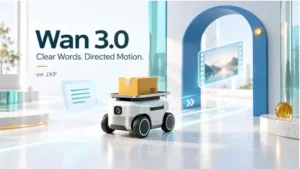
Imagine an original animation for a technology article: a small delivery robot carries a yellow parcel towards a blue arch. It stops, a lamp on the arch turns green, and the robot continues underneath. This is a fictional visual example, not a demonstration of a real delivery system.
There are two different briefs hidden in that description. One establishes the objects: robot, parcel, arch and lamp. The other establishes their behaviour. Keeping them separate makes it easier to see whether the instruction actually contains the event the author wants.
“A friendly silver robot in a clean futuristic space” supplies appearance. “The robot stops before the arch” supplies action. Neither can replace the other. A beautiful silver robot that never stops has missed a central part of the scene, however polished the lighting looks.
Repeated nouns can be better than elegant pronouns
Good prose often avoids repeating the same noun. Instructions sometimes benefit from doing the opposite. In the opening sentence, replacing “it” with “the signal lamp” removes a choice the reader should not have to make.
Compare these two directions:
The robot stops beside the arch and turns towards it as it lights up.
The robot stops before the blue arch. The robot faces the opening. The small lamp at the top of the arch turns green.
The second version is less literary, but the participants are easier to identify. It also exposes another decision: the robot is before the arch, not beside it. That difference affects whether its next movement looks like passing through an opening or turning around a structure.
Not every sentence needs this treatment. Once the scene has only one moving subject and the meaning is obvious, pronouns may be perfectly clear. Repeat names where they resolve a real ambiguity, rather than making every line sound like a legal definition.
“While” and “after” describe different videos
“The robot moves through while the lamp turns green” makes the events overlap. “The robot moves through after the lamp turns green” establishes an order. “The robot stops until the lamp turns green” adds a waiting condition. These are not cosmetic variations.
For the fictional demonstration, write the sequence as three short beats:
- The robot approaches the arch and comes to a complete stop before the opening.
- While the robot remains still, the lamp changes from amber to green.
- After the colour change is visible, the robot moves forwards beneath the arch.
This does not turn the prompt into executable code. The generator can still omit, merge or reorder events. The benefit is that an error becomes recognisable: a robot that never pauses is different from one that pauses but leaves before the lamp changes.
Sequence and causation also need separating. A green lamp followed by movement suggests a response in this invented scene; it does not prove that a real machine detected a signal. If the article were explaining an actual system, recorded evidence or a technically accurate animation would be needed to establish that mechanism.
Give the camera its own sentence
“Move towards the arch” leaves another participant unnamed. Is the robot moving, or is the camera pushing forward? Combining subject motion and camera direction in the same loose instruction can obscure what should change on screen.
A side view suits this example because the stopping point remains visible. Specify that the camera stays fixed and keeps both the robot and the lamp in view. The robot’s movement then has a stable background against which it can be judged.
A close-up might show the lamp beautifully but hide the robot crossing too early. A sweeping camera move might make a stationary robot appear to advance. Choose the view that makes the action understandable before adding a move for visual excitement.
Sound needs the same clarity. If a short chime is wanted, connect it explicitly to the lamp turning green. Otherwise a beep somewhere in the clip may feel decorative rather than informative. Keep it out of the brief altogether if the example works better without it.
Build a prompt that can be read back as a scene
Wan 3.0 text-to-video is a suitable starting route when the robot and its setting are still being invented in words. An image reference becomes more useful once their visual design is settled. There is little value in adding a reference that depicts the robot already beyond the arch if the intended opening shows it approaching.
A compact version of the proposed brief might read:
A small silver delivery robot carries one yellow parcel on a flat tray towards a blue arch in a simple studio setting. Fixed side view showing the robot, the opening and the signal lamp. The robot stops before the arch. While the robot waits, the lamp changes from amber to green with a short chime. The robot then moves underneath the arch. Keep the parcel on the tray throughout.
The example describes an intention, not a verified generation result. It leaves room for interpretation in the robot’s design while being specific about the action. More detail would be justified if the shape of the parcel mattered; decorative background machinery would add little to this particular explanation.
When watching the result, describe what actually happened in one sentence without looking at the prompt. If that sentence says “the robot drives through a glowing arch,” the waiting step has disappeared from the story. Revise the instruction or choose another take based on that missing event, not on a vague feeling that the clip needs to be more cinematic.
A useful prompt is not the one with the most impressive vocabulary. It is the one that makes the intended action easy to recognise—and makes a different action equally easy to spot.
Also Read
- Unlocking Youthful Skin: The Wonders of Microneedling Pen Technology
- What Is an AI Smut Writer and Why SmutFinder Is Built Specifically for It
- How Technology Is Raising the Bar for Safety and Performance Standards Across Industrial Sectors