In the modern digital classroom, we are surrounded by automated safety nets. We have autocorrect for our quick messages, predictive text for our emails, and basic spell-checkers built into every word processor. For a student racing against a midnight deadline, these tools feel like a lifeline. However, there is a growing gap between a document that is “error-free” according to a computer and a document that is truly “academic.”
While basic software can catch a typo or a repeated word, it often lacks the nuanced understanding of context, tone, and complex disciplinary language. Relying solely on automated highlights can lead to a false sense of security. To produce work that truly resonates with professors and meets the rigorous standards of higher education, students must move beyond the red underline and embrace the art of manual grammar review.
The Limits of Automated Algorithms
Most standard word processors operate on a set of rigid rules. They are excellent at identifying “mechanical” errors—things like missing periods or misspelled common nouns. But academic writing is rarely mechanical. It is fluid, sophisticated, and often uses specialized terminology that can confuse a basic algorithm.
When you are deep in the drafting phase, your focus is on getting ideas onto the page. This is where a specialized grammar checker online becomes an invaluable bridge between your first draft and your final submission. Unlike the generic tools found in basic software, a dedicated tool from a source like myassignmenthelp is often designed with academic structures in mind, helping to flag passive voice, awkward phrasing, and misplaced modifiers that standard checkers might overlook. However, even with this technological assist, the final “seal of approval” must come from the student’s own critical eye.
The primary limitation of any AI-driven tool is its inability to understand intent. A computer doesn’t know if you meant to use a specific jargon or if you are intentionally using a complex sentence structure to emphasize a point. By performing a manual review, you ensure that the software is serving your message, rather than the other other way around.
Why “Clean” Writing Isn’t Always “Good” Writing
A paper can have perfect grammar and still be a poor piece of academic work. This is the “Spam Trap” of student writing: focusing so much on technical correctness that the logic and flow are sacrificed. Manual review allows you to look at the architecture of your essay.
- Logical Flow: Does paragraph A lead naturally into paragraph B?
- Argument Strength: Is your thesis statement supported by the evidence provided?
- Vocabulary Variety: Are you using the same three adjectives over and over?
When you read your work aloud, you notice things a computer never will. You’ll hear where a sentence is too long and causes the reader to lose breath. You’ll notice where a transition feels clunky. This level of scrutiny is what separates a “B” paper from an “A” paper.
Identifying the “Invisible” Errors
There are several types of errors that automated systems notoriously struggle with. These are the “red flags” that professors notice immediately:
- Homophones and Contextual Misuse: A computer might not flag “their” instead of “there” if both are spelled correctly, depending on the complexity of the sentence.
- Dangling Modifiers: These occur when a descriptive phrase doesn’t clearly relate to the word it’s supposed to modify (e.g., “After rotting in the cellar, the gardener found the onions”). The grammar is technically “fine” to a computer, but the meaning is absurd.
- Tone Inconsistency: Shifting from formal academic language to “slang” or “casual” phrasing is a common student error.
For students balancing multiple subjects, the pressure can be immense. When the workload reaches a breaking point, many find that supplemental assignment help can provide the necessary external perspective. Engaging with experts doesn’t just “fix” a paper; it serves as a learning opportunity to see how professional writers handle these invisible errors. This guidance, combined with your own manual review, creates a powerful feedback loop that improves your writing skills over time.
A Step-by-Step Manual Review Strategy
To make your review process more effective without feeling overwhelmed, try breaking it down into “passes.”
Pass 1: The “Macro” View (Structure and Logic)
Before looking at commas, look at your arguments. Does the essay answer the prompt? If the foundation is weak, perfect grammar won’t save it. Ensure your topic sentences align with your conclusion.
Pass 2: The “Audio” Test
Read your entire paper out loud. If you stumble over a sentence, it’s a sign that the syntax is too complex or the punctuation is incorrect. This is the single most effective way to catch “clunky” writing.
Pass 3: The “Micro” View (Grammar and Punctuation)
Now, look for the technicalities. Check your citations, look for subject-verb agreement, and ensure your punctuation is consistent (e.g., using the Oxford comma throughout).
Pass 4: The Reverse Read
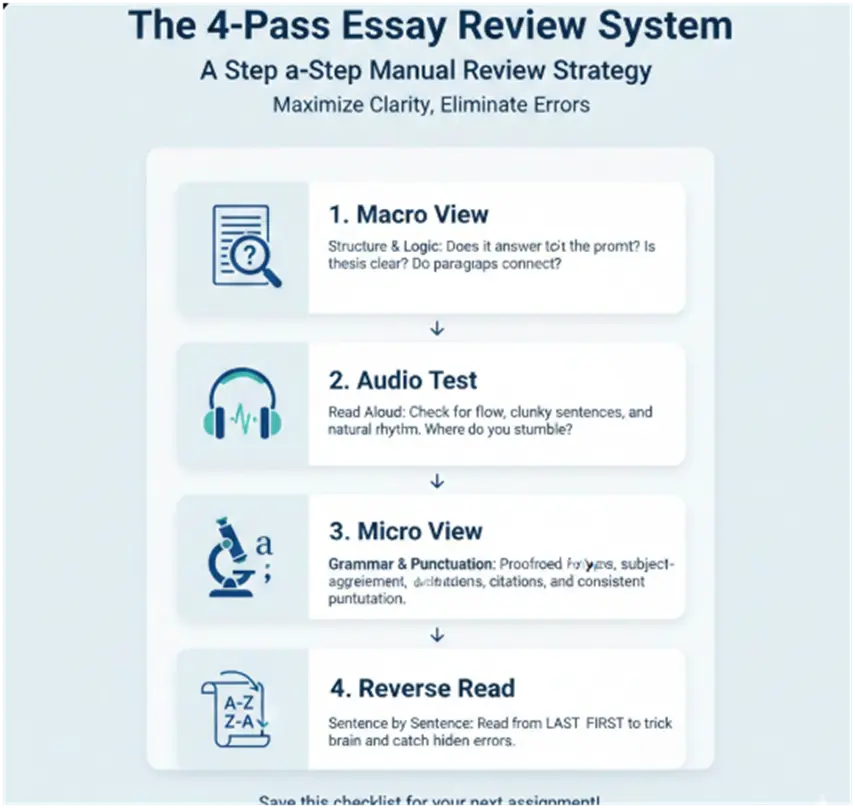
Try reading your paper from the last sentence to the first. This “tricks” your brain into seeing each sentence as an individual unit, making it much easier to spot typos that your brain would otherwise skip over because it already knows the “story” of the essay.
The Long-Term Benefits of Grammar Mastery
Developing a habit of manual review does more than just help you pass a single class. It builds a skill set that is highly valued in the professional world. Whether you end up in law, medicine, engineering, or the arts, the ability to communicate clearly and professionally is a universal requirement.
In a professional setting, a report filled with grammatical errors suggests a lack of attention to detail and a lack of respect for the reader. By mastering these skills now—using a mix of self-correction, high-quality online tools, and expert guidance—you are investing in your future career.
Conclusion
Technology is a wonderful servant but a poor master. Tools like spell-checkers and specialized academic checkers are essential components of a modern student’s toolkit, but they should be the beginning of the editing process, not the end.
About the Author
Hi, I’m James. I am a dedicated academic consultant and contributing writer at MyAssignmentHelp, where I focus on helping students bridge the gap between classroom theory and professional writing standards. With years of experience in the education sector, I’ve seen firsthand how mastering the nuances of language can transform a student’s academic trajectory.
Also Read-Super88 and Slot88: Redefining Online Slot Experiences